
The retail florist industry is at a crossroads. While the demand for fresh flowers remains strong, traditional brick-and-mortar florists face numerous challenges, including rising operating costs, competition from online retailers, and changing consumer behaviors. To thrive in this evolving landscape, retail florists must adapt and embrace innovative business models that leverage technology and streamline operations.
One such model involves transforming a retail flower shop into a production and distribution hub, servicing multiple HyperVend vending machines and mobile trucks for 24/7 on-demand delivery, all while implementing dynamic pricing and live inventory control. This approach offers a scalable and efficient way for florists to expand their reach and increase sales without the need for additional physical stores.
HyperVend’s refrigerated vending machines provide a unique platform for florists to offer fresh flowers and arrangements 24/7, in high-traffic locations like airports, malls, and office buildings. The machines’ sleek design and user-friendly interface attract customers, while the secure payment system ensures smooth transactions. By partnering with HyperVend, florists can expand their customer base, boost brand awareness, and generate additional revenue streams.

HyperVend’s mobile truck option offers an even more dynamic sales channel, allowing florists to bring their products directly to customers’ doorsteps. With on-demand delivery, customers can order flowers anytime and receive them within hours,perfect for last-minute gifts or special occasions. By incorporating dynamic pricing and live inventory control, florists can optimize their pricing strategies and ensure product availability, maximizing profitability.
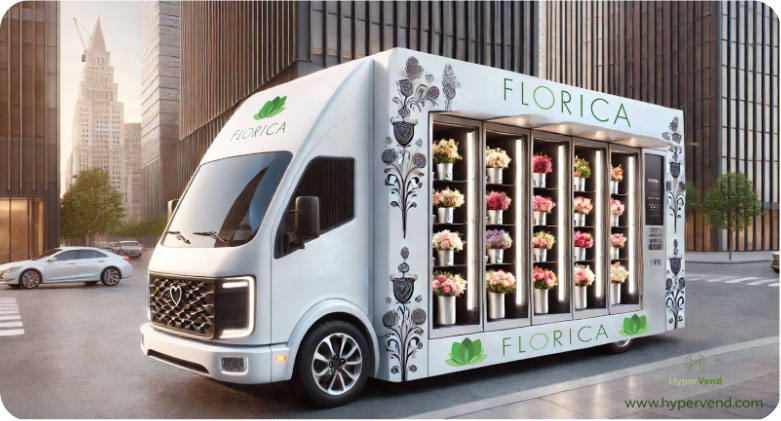
To implement this business model, florists must adapt their operations and focus on production and distribution. This involves streamlining floral arrangements, optimizing live inventory management, and investing in delivery infrastructure.
The retail flower shop becomes the central production and distribution hub, supplying fresh flowers and arrangements to HyperVend machines and mobile trucks. Florists must reorganize their workspace to accommodate increased production volume and efficient order fulfillment.
Florists should focus on creating a core selection of popular and versatile arrangements suitable for vending machines and on-demand delivery. This ensures efficient production, reduces waste, and simplifies inventory management.
Implementing live inventory control allows florists to track product availability in real-time, ensuring that HyperVend machines and mobile trucks are always stocked with fresh flowers. This minimizes waste, improves customer satisfaction, and maximizes sales opportunities.
Investing in a reliable delivery fleet, equipped with refrigeration capabilities, is crucial for on-demand delivery. Florists can partner with third-party delivery services like Door Dash and Uber or build their own in-house team, ensuring timely and efficient delivery of fresh flowers.
Implementing dynamic pricing allows florists to adjust prices based on demand, time of day, and other factors,maximizing revenue and profitability. Targeted marketing campaigns, leveraging social media and other digital channels, can promote the convenience of HyperVend machines and on-demand delivery, driving customer engagement and sales.

By expanding their reach through HyperVend machines and mobile trucks, florists can tap into new customer segments and generate additional sales, significantly increasing revenue.
This model eliminates the need for additional physical stores, reducing overhead costs associated with rent, utilities,and staffing.
Streamlining production, optimizing inventory management, and leveraging technology lead to improved operational efficiency, reducing waste and maximizing profitability.
Offering 24/7 access to fresh flowers through HyperVend machines and on-demand delivery caters to modern consumer preferences, improving customer satisfaction and loyalty.
This model is highly scalable, allowing florists to expand their operations and reach new markets without significant capital investment.
The future of retail floristry lies in embracing technology and innovative business models. By transforming their flower shops into production and distribution hubs, servicing HyperVend machines and mobile trucks for on-demand delivery,florists can expand their reach, increase sales, and thrive in the competitive floral industry. This model empowers florists to meet the evolving needs of modern consumers while maximizing efficiency and profitability.
Remember, success in this model requires careful planning, adaptation, and a commitment to providing exceptional customer service. By leveraging HyperVend’s technology and implementing dynamic pricing and live inventory control, florists can revolutionize their business and achieve sustainable growth in the years to come.
In today’s retail florist landscape, businesses are faced with rising operational costs, shifting consumer behaviors, and increasing competition from online sellers. For companies looking to expand into new markets or maximize profitability, the decision between investing in traditional brick-and-mortar stores or leveraging innovative models like vending machines and mobile flower trucks is crucial. This analysis compares the financial implications of opening one traditional store versus a hybrid model combining one store, five HyperVend vending machines, and five mobile HyperVend flower trucks. We will also evaluate the impact of scaling up to five stores within the same city compared to the hybrid model.
When opening a traditional retail florist store, the initial upfront costs typically range between $150,000 and $200,000. This includes:
For comparison, setting up one retail flower shop, supplemented by five HyperVend vending machines and five HyperVend mobile flower trucks, involves much lower upfront capital outlay. Here’s a breakdown:
Thus, the total upfront cost for the hybrid model (one store + 5 vending machines + 5 mobile trucks) is $231,000 ($150,000 + $36,000 + $45,000). This figure is significantly lower than the $750,000-$1,000,000 investment needed to open five traditional stores (at $150,000-$200,000 per store).
A significant advantage of the hybrid model is the lower ongoing fixed and operational costs. Each traditional store incurs:
Revenue generation is another critical area where the hybrid model outperforms the traditional store setup. Here’s a comparison of expected revenue:
Combined, the hybrid model (store + machines + trucks) could generate anywhere from $1,200,000 to $1,800,000 annually, compared to the $3,000,000 generated by five brick-and-mortar stores. While the total sales figure for five stores is higher, the hybrid model’s significantly lower fixed costs make it much more capital efficient, as explained in the ROI analysis below.
The return on investment (ROI) is a key financial metric for determining the efficiency of capital deployment. Here’s the ROI comparison based on the first-year total investment and potential revenue.
As these figures indicate, the hybrid model offers a far superior ROI compared to both one store and five traditional stores. Even though the hybrid model generates slightly less revenue than five stores, its lower upfront investment and significantly reduced operating costs lead to higher profitability and greater capital efficiency.
Another critical advantage of the hybrid model is its scalability and flexibility. Setting up five stores in a single city involves committing to long-term leases, potentially locking the business into expensive commercial spaces. These leases can be difficult to break, and any change in market conditions or customer preferences can lead to substantial sunk costs. Additionally, scaling a brick-and-mortar operation to multiple locations within a city increases the risk of market saturation and cannibalization.
In contrast, the hybrid model is highly scalable. HyperVend machines and HyperVend mobile trucks can be placed or parked in high-traffic areas without the need for long-term commitments. Machines can be relocated based on demand, and trucks can adjust their routes to capture peak sales opportunities. This flexibility allows for optimized sales coverage and customer reach with minimal capital investment.
Modern consumers increasingly prefer convenient, quick purchasing options. With HyperVend machines offering 24/7 access to fresh flowers and HyperVend mobile trucks enabling on-demand delivery, the hybrid model caters to this preference. Traditional stores, on the other hand, are limited by regular business hours and geographical constraints. By diversifying sales channels and offering both self-service and mobile options, the hybrid model enhances the customer experience, driving customer satisfaction, repeat purchases, and brand loyalty.
In conclusion, the financial analysis clearly demonstrates that adopting a hybrid model combining one store, five HyperVend vending machines, and five HyperVend mobile flower trucks is far more capital-efficient and profitable compared to opening five traditional stores in a single city. The hybrid model requires a significantly lower upfront investment and generates comparable, if not greater, returns due to reduced fixed costs, higher scalability, and flexible operations.
Given the rapid changes in consumer behavior and the increasing demand for convenience, the hybrid model also positions florists to better adapt to future market trends. By embracing innovative technologies and scalable business models like HyperVend flower vending machines and HyperVend mobile flower trucks, florists can expand their operations more efficiently and capture a larger share of the market without the heavy financial burden of traditional retail expansion.
HyperVend offers a revolutionary retail automation solution that helps companies, of all sizes, compete in today’s digital economy.
© 2024 HyperVend, Inc. All Rights Reserved
For North and South America, chat here on EST time


